The Government of Saskatchewan is launching a new Capabilities and Skills Framework in Spring 2026 with GEM Deployment Two. This framework will replace all existing competency models: SGEU, CUPE and Leadership and Management models. This new framework will apply to all in-scope and out-of-scope employees.
You can find more information in this Key Messages and Questions and Answers document.
An e-learning module is available on PSC Client that introduces the framework.
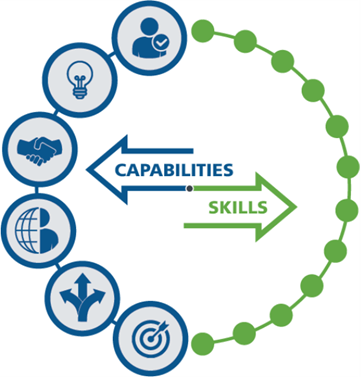
Transition to the new framework will be phased in. Refer to the Manager’s Toolkit to determine if capabilities and skills or competencies apply to your situation. If you require clarification on which approach to use, please contact your Human Resource Business Partner.
What are capabilities and skills?
Capabilities are qualities, traits or attributes consistently demonstrated by individuals, regardless of context or situation, that contribute to organizational success.
The six capabilities listed in this framework are: accountable, adaptable, collaborative, inclusive, innovative and outcomes focused.
Skills are demonstrated abilities or proficiencies that are acquired or developed through training, practice and/or experience and are required for effective execution or performance of duties. Many positions only require some of them.
The 12 skills listed in this framework are: communication, critical thinking, data literacy, digital skills, health, safety and wellness, influence, interacting with others, managing organizational resources, managing self, managing talent, navigating ambiguity and political and organizational awareness.
Capabilities and skills, along with role-specific knowledge and technical skills, describe what it takes to successfully perform the duties of a job.
Explore the Capabilities and Skills Framework
The Capabilities and Skills Framework is our foundation in attracting, engaging and growing talent throughout the employee life cycle in the Government of Saskatchewan.
We use capabilities and skills as a measure to determine who we hire, how well an employee performs and what strengths and development opportunities an employee requires to master new skills and move into new roles.
Capabilities and skills align to positions
Capabilities and skills are aligned to a position’s job description. An individual uses the required capabilities and skills to carry out the primary responsibilities of the position.
Profiles are available for deputy minister, assistant deputy minister and executive director.
For SGEU in-scope positions, knowledge statements from the previous SGEU Competency Profiles are available for several occupations to help identify appropriate statements. The statements in the tool are samples and other relevant knowledge statements may be applicable.
The capabilities and skills required for a position are identified in GEM. Managers may decide some of the capabilities and skills are required for recruitment and demonstrated on day one in the new job. The remainder of the capabilities and skills are expected to be developed during an employee’s probationary period and are not assessed as requirements within the initial staffing process. They are also further developed throughout an employee’s career and they support work planning, talent planning and career management.
Capabilities and skills throughout the employee life cycle
Capabilities and skills are used as the foundation to:
- "Attract" employees (Recruitment and Staffing);
- "Engage" employees (Probation and Work Planning); and
- "Grow" employees (Talent (Succession) Planning and Career Management).
Capabilities, skills, knowledge and technical skills are used as a measure to determine who we hire, how well an employee performs and what strengths and development opportunities an employee requires in order to master new skill sets and move into new roles.
Attract
Recruitment and staffing
Recruitment capabilities, skills, knowledge and technical skills (i.e., recruitment qualifications) are used throughout the entire recruitment and staffing process, from job ads to screening questions, exercises and interview guides to reference checks. See hire an employee for more information on recruitment and staffing.
Engage
Probation
Capabilities, skills, knowledge and technical skills are used throughout the onboarding and probationary period to guide the development, demonstration and assessment of an employee's performance in the position. Both recruitment and development qualifications for the position will inform these conversations. See probationary period for more information on in-scope and out-of-scope probationary period.
Work planning
Employee work planning is an opportunity for an employee to have a conversation with their manager about the employee's work objectives, capability and skill objectives, learning and development objectives and career path.
The conversation includes:
- The capabilities, skills, knowledge and technical skills needed to achieve the current work objectives;
- A comparison of the capabilities, skills, knowledge and technical skills an employee has and those an employee needs to develop to achieve the work objectives; and
- The capabilities, skills, knowledge and technical skills an employee wants to develop for future career goals.
See the work planning Taskroom page for more information on in-scope and out-of-scope work planning.
Grow
Talent planning
Talent planning includes succession planning activities and is the process of identifying the talent and capabilities, skills, knowledge and technical skills the organization needs, comparing it to the talent and capabilities, skills, knowledge and technical skills the organization has, and creating a plan to address the gaps.
Recruitment capabilities and skills are used in succession planning because the goal is to develop potential successors for future roles.
Contact your HR Business Partner for more information.
Career management
Career management is a lifelong, self-monitored process that involves choosing and setting personal goals and formulating strategies for achieving them.
Capabilities and skills are used in career planning as a measure of what is required to be successful in a specific role(s).
An employee can develop a plan to grow their capabilities and skills by selecting the capabilities and skills required to take the next step in their career journey and adding them to the learning and development objectives in their current work plan. Visit the Professional Development Taskroom page for more information on learning and development opportunities within the Government of Saskatchewan.
For more information on capabilities and skills and how to use them throughout the employee life cycle, please contact your HR Business Partner
